
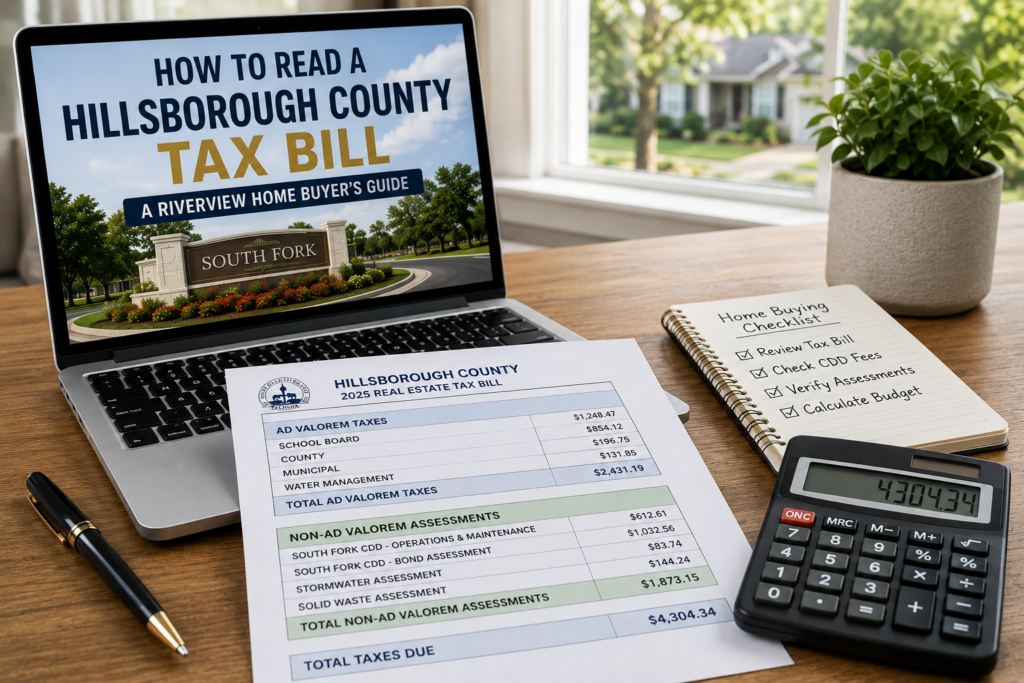
How to Read a Hillsborough County Property Tax Bill in 60 Seconds: A Riverview Home Buyer’s Guide
Updated September 2026
If you are buying a home in Riverview or another part of Hillsborough County, knowing how to read a Hillsborough County property tax bill is essential. This is especially important when considering a home in a planned community such as South Fork, where the property tax amount shown on a real estate listing should be the beginning of your research, not the end.
One of the most important numbers may be sitting in the non-ad valorem assessment section of the property tax bill.
For professionals relocating to Riverview, understanding the difference between ad valorem property taxes and non-ad valorem assessments can help you develop a more accurate picture of a property’s annual ownership costs.
And if you’re considering South Fork, there’s another term you should understand:
CDD.
Here’s how to review a Hillsborough County property tax bill in about 60 seconds.
What Is the Difference Between Ad Valorem and Non-Ad Valorem Taxes in Hillsborough County?
Here’s the simple distinction:
Ad valorem taxes are based on property value. Non-ad valorem assessments are charges associated with a benefit or service to property rather than being calculated from the property’s value.
The Hillsborough County Tax Collector explains the local property-tax process, including the roles of the Property Appraiser, taxing authorities, and Tax Collector. The Tax Collector also identifies municipal and non-ad valorem special-district taxing authorities.
The Florida Department of Revenue explains that counties, municipalities, and special districts can levy non-ad valorem assessments. These assessments are calculated on a unit basis rather than on property value and can relate to improvements or services such as drainage, lighting, or paving.
Why does this matter when buying a Riverview home?
Because looking only at the purchase price or an online property-tax estimate may not tell you the entire story.
Step 1: Review the Ad Valorem Taxes
Start with the ad valorem portion of the property tax bill.
“Ad valorem” essentially means according to value. These property taxes are connected to taxable property value and applicable millage rates.
But there is an important detail for buyers:
Do not assume the seller’s current property tax bill will equal your future property tax bill.
The seller’s existing bill reflects the property’s circumstances under the current assessment and exemptions. The Hillsborough County tax process also separates the roles of the Property Appraiser, taxing authorities, and Tax Collector.
Your circumstances after purchasing the property may be different.
That means the seller’s tax bill is an excellent research tool, but it should not be treated as a guarantee of your future property tax liability.
Step 2: Find the Non-Ad Valorem Assessments
Now look for the non-ad valorem assessments.
This is where Riverview buyers should slow down and read the entire bill.
According to the Florida Department of Revenue’s guidance on non-ad valorem assessments, these assessments are calculated on a unit basis rather than on property value.
Depending on the property and applicable taxing authorities, this portion may contain assessments connected with services, infrastructure, or special districts.
For buyers considering homes in planned communities, one item that deserves particular attention is a Community Development District assessment, commonly called a CDD assessment.
What Is a CDD in Florida?
A Community Development District, or CDD, is a type of independent special district authorized under Florida law as a method for managing and financing basic services for community development.
Florida’s statutory framework for CDDs is contained in Chapter 190 of the Florida Statutes. Chapter 190 addresses the establishment, powers, budgets, bonds, taxes, non-ad valorem assessments, special assessments, and other aspects of Community Development Districts.
Depending on the district, CDD responsibilities can involve qualifying public improvements and community facilities.
That brings us directly to South Fork.
Does South Fork in Riverview Have a CDD?
Yes. South Fork in Riverview, Florida has an established Community Development District.
The South Fork Community Development District’s official website provides the district’s public information and records.
The district operates within Florida’s Community Development District framework under Chapter 190, Florida Statutes. Florida law provides the statutory framework governing CDD establishment and operations.
For someone considering a home in South Fork, this means the CDD should be part of the property-specific financial research completed before purchasing.
Why the South Fork CDD Matters When Comparing Homes
Imagine you’re relocating to Riverview and comparing two homes with similar purchase prices.
At first glance, their projected housing expenses might appear almost identical.
But their actual property tax bills and applicable non-ad valorem assessments may not be identical.
That leads to one of the most important takeaways in this article:
Two homes with similar purchase prices do not necessarily have identical property tax bills.
This is why I encourage buyers to look beyond the number generated by an online mortgage calculator.
A more complete comparison may include:
Purchase price + financing + estimated future property taxes + non-ad valorem assessments + homeowners insurance + HOA fees + other applicable ownership costs.
The goal is to compare properties using the fullest financial picture available.
Step 3: Verify the Numbers Before You Make an Offer
This is the step I would not skip.
Before relying on an estimated monthly payment for a Riverview property, verify the specific property, not simply the neighborhood or subdivision.
Your 60-Second Property Tax Checklist
Before making an offer, review:
- The property’s current Hillsborough County tax information
- The ad valorem taxes
- Every applicable non-ad valorem assessment
- Any applicable CDD assessment
- The current CDD budget and assessment schedule
- Available information concerning applicable CDD bond assessments or payoff
For a South Fork property, buyers can review the South Fork CDD financial documents and adopted budgets.
This is a particularly useful primary source. The district states that current fiscal-year assessment schedules can be found in its adopted budget. Its financial page also provides contact information for CDD fees, assessments, and bond information.
The district’s South Fork CDD Documents page also specifically directs users looking for debt-assessment charts to the end of the latest adopted budget files.
That is much more reliable than assuming every property in South Fork has exactly the same financial circumstances.
Does a CDD Assessment Depend on the Value of Your Home?
A non-ad valorem assessment is not calculated in the same way as an ad valorem property tax based on property value.
The Florida Department of Revenue explains that non-ad valorem assessments are calculated on a unit basis rather than on value.
That distinction is important.
A property tax bill can contain ad valorem taxes based on property value as well as non-ad valorem assessments.
This is one reason buyers should be careful about estimating ownership expenses based solely on a home’s purchase price.
Do South Fork CDD Assessments Ever Go Away?
This question deserves a property-specific answer.
CDD assessments can involve different financial components, and buyers should not assume that an assessment will automatically disappear on a particular date.
The South Fork CDD states that its current fiscal-year assessment schedules are included in the adopted budget. The district also provides dedicated contact information for CDD fees and bond information.
If you’re purchasing in South Fork, verify the assessment applicable to the specific property.
For questions about a particular assessment, debt assessment, or bond payoff, use the district’s current records and contact information rather than relying solely on a listing, previous year’s amount, neighbor, or online discussion.
Where Can I Find CDD Assessments on a Hillsborough County Property Tax Bill?
Start by looking for the non-ad valorem assessment portion of the property’s tax information.
The Florida Department of Revenue explains that proposed non-ad valorem assessments usually appear at the bottom of the Notice of Proposed Property Taxes, although taxing authorities can also send them separately.
For South Fork, cross-reference property-specific tax information with the South Fork CDD’s current adopted budget and assessment schedules.
This gives you two important pieces of the puzzle:
Property-specific tax information + current district information.
A Simple Example for Someone Relocating to Riverview
Suppose you’re comparing two Riverview homes at similar price points.
Home A has one combination of applicable non-ad valorem assessments.
Home B has another.
If you only compare:
Purchase price + estimated mortgage payment
the properties may appear financially similar.
But once you compare:
Mortgage + estimated property taxes + non-ad valorem assessments + insurance + HOA + applicable ownership expenses
you may get a different picture.
That is why local tax research is best done before you become financially committed to a property.
How to Read a Hillsborough County Property Tax Bill in 60 Seconds
Remember these three steps:
Step 1: Check the Ad Valorem Taxes
These are the value-based property taxes.
Step 2: Check the Non-Ad Valorem Assessments
Look for applicable CDD and other assessments.
Step 3: Verify the Property-Specific Numbers
Use official Hillsborough County, State of Florida, and applicable CDD records before relying on an estimated monthly housing payment.
That’s it.
The goal isn’t to label a CDD as good or bad. The goal is to understand what you are paying, why you are paying it, and how it fits into your overall housing budget before you make a purchasing decision.
For professionals relocating to Riverview, Florida, that little bit of local due diligence can make comparing properties much clearer.
Frequently Asked Questions About Riverview CDDs and Property Taxes
What is a non-ad valorem assessment in Hillsborough County?
A non-ad valorem assessment is generally based on a unit or benefit associated with property rather than being calculated from the property’s value. Florida’s Department of Revenue gives drainage, lighting, and paving as examples of improvements or services that can be associated with these assessments.
Are CDD assessments the same as regular property taxes?
No. Florida law separately addresses taxes and non-ad valorem assessments within its Community Development District framework.
Always verify the actual assessments applicable to the specific property you are considering.
Does South Fork in Riverview have a CDD?
Yes. South Fork Community Development District maintains official district records, financial documents, adopted budgets, and assessment information.
Where can buyers verify South Fork CDD assessments?
Review the property’s current tax information and the South Fork CDD financial documents and adopted budgets. The district states that its current fiscal-year assessment schedules are contained in the adopted budget.
Should I use the seller’s current property tax bill to estimate my future taxes?
Use it as a starting point, not a guarantee.
A buyer’s future tax circumstances may differ from the seller’s. Verify current property information and consult the appropriate government agencies and professionals when developing your ownership-cost estimate.
About the Author
Ollie Green is a retired U.S. Army veteran, licensed Florida real estate broker, and owner of Fleur De Lis Luxe Realty®.
She lives in the South Fork community of Riverview, Florida, giving her firsthand familiarity with the community and the local real estate market.
Ollie serves first-time homebuyers, VA buyers, new construction buyers, and relocation clients throughout Riverview and the SouthShore Tampa Bay area.
Her work focuses on helping buyers understand the local details that can affect homeownership costs and purchasing decisions, including property taxes, Community Development District assessments, new construction, and relocation considerations.
Educational Disclaimer: This article is provided for general educational purposes and is not tax, legal, lending, or financial advice. Property taxes, assessments, exemptions, district budgets, and other ownership costs can change. Buyers should verify current information for the specific property with the appropriate government agency, Community Development District, lender, insurance professional, attorney, tax professional, or other applicable professional.


